About Pneumatic Angle Type Control Valve
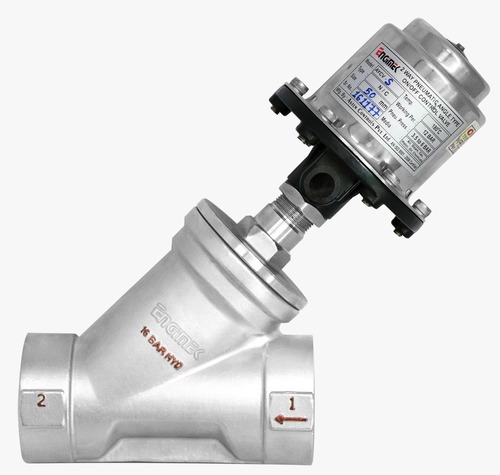
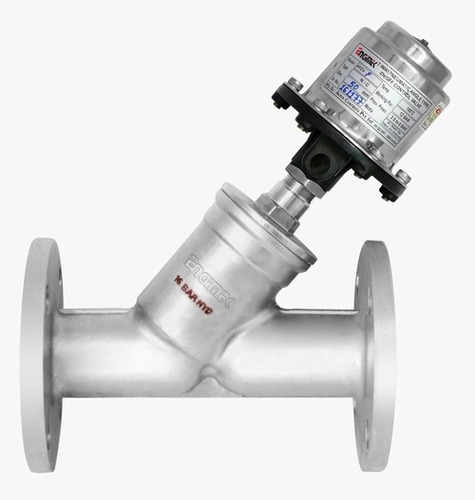
We are offering industrial grade Pneumatic Angle Type Control Valve which is especially designed for the medium to high pressure flow systems to control the fluid flowing rate within the different branches of the flow systems. It is machined with advanced technologies which gives excellent finish to the inner as well as outer surfaces of this fitting. This valve is also provided with an anti-corrosive which gives excellent protection against acidic, neutral and alkaline liquids.
Pneumatic Angel Type Control Valve Specifications:
1. Material: SS304
2. Body Style: Y Type
3. Connection Type: Screwed, Flanged, Tri Clover
4. Size: 15 mm--100 mm
5. MOC: SS304
6. Working Pressure: PN16
7. End connection: Screwed, Flanged
8. Media: AIR / STEAM / GAS /WATER / OIL / CHEMICAL
9. Pneumatic Pressure: 3.5 to 7 BAR
FAQ:
Q: What is a pneumatic angle type control valve?
A: A pneumatic angle type control valve is a type of control valve used to regulate the flow of fluids (liquids or gases) in industrial processes. It's called "angle" because the valve body is designed at an angle, usually 90 degrees. This design helps to minimize pressure drop and turbulence in the flow, making it suitable for applications where flow control and pressure drop reduction are important.
Q: How does a pneumatic angle type control valve work?
A: The valve operates by using pneumatic pressure to control the position of the valve's internal mechanism, typically a throttling element like a plug or a ball. When the control system sends a signal, the pneumatic actuator adjusts the position of the throttling element, thereby regulating the flow of fluid through the valve.
Q: What are the advantages of using pneumatic angle type control valves?
A: Pneumatic angle type control valves offer several advantages, including fast response times, reliability, and suitability for high-pressure applications. They are also less sensitive to environmental conditions compared to electronic control systems. Additionally, the angle design helps to reduce pressure drop and the risk of cavitation, making them ideal for applications with varying flow rates.
Q: What are some typical applications for pneumatic angle type control valves?
A: These valves are commonly used in industries such as oil and gas, chemical processing, power generation, water treatment, and more. They are suitable for controlling the flow of various fluids in processes that require precise regulation to maintain desired conditions such as pressure, temperature, or flow rate.
Q: How is the pneumatic actuator controlled?
A: The pneumatic actuator of the valve is controlled by a pneumatic control system. This system includes instruments like pressure regulators, positioners, and controllers. The control system receives signals from sensors that monitor process conditions, and based on these signals, it adjusts the position of the actuator to control the valve's opening and closing.
Q: What maintenance do pneumatic angle type control valves require?
A: Regular maintenance is essential to ensure the optimal performance of pneumatic angle type control valves. This includes checking for air leaks, cleaning or replacing filters, lubricating moving parts, and calibrating the control system. Proper maintenance helps extend the valve's lifespan and ensures accurate control.
Versatile Design for Diverse ApplicationsWith angle type body and manifold options (single or double acting), the control valve is adaptable for various industrial settings. Inline mounting and the choice of both screwed and flanged end connections make installation flexible. Supported port sizes range from 1/2 to 4 inches, suitable for most process requirements.
Superior Materials Ensure ReliabilityConstructed from high-quality stainless steel or bronze and equipped with PTFE, EPDM, or Viton seals, the valve provides excellent corrosion resistance and tight sealing to ANSI Class VI leakage standards. The aluminium actuator contributes to lightweight durability, while different surface finishes enhance longevity.
FAQ's of Pneumatic Angle Type Control Valve:
Q: How is the Pneumatic Angle Type Control Valve installed?
A: This control valve can be mounted inline or for on/off operation, depending on system requirements. Installation is versatile, with options for either screwed or flanged connections, and supports both BSP and NPT thread types for seamless integration into existing pipelines.
Q: What types of media can this valve handle?
A: The valve is engineered to efficiently regulate air, water, oil, and steam. Its material combinations and seal selections accommodate a broad temperature range (-10C to +180C), making it suitable for diverse industrial processes.
Q: When should I use a single or double-acting manifold?
A: Single-acting manifolds are ideal for applications requiring actuation in one direction with a spring return, while double-acting types provide actuation in both directions, offering enhanced control for more demanding process needs.
Q: Where is this valve typically used?
A: Commonly deployed in process industries, manufacturing plants, and utility systems across India, the valve suits roles in flow control, shut-off, and regulation of media in pipelines and vessels.
Q: What control signals and voltages are supported?
A: The control valve operates with pneumatic signals ranging from 3 to 8 bar. Its actuator supports electrical inputs of 24V DC or 230V AC for versatile compatibility with various automation systems.
Q: What are the main benefits of using this control valve?
A: Key advantages include fast response time (<2 seconds), precise flow characteristics (linear or equal percentage), high-pressure handling up to 16 bar, and leakage performance up to ANSI Class VI, ensuring efficiency, reliability, and minimal process losses.





 Send Inquiry


 Send Inquiry
 Send Inquiry
 Send SMS