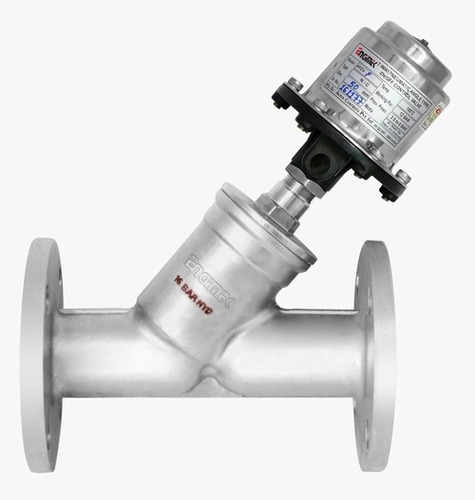
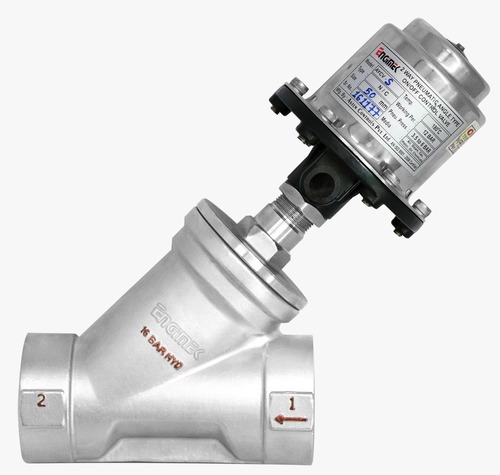
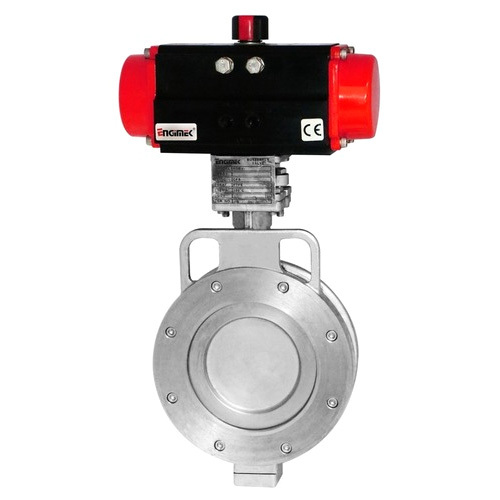
About Pneumatic Angle Control Valve Flange End
Buy from us premium quality Pneumatic Angle Control Valve Flange End that is specially designed for medium to high pressure flow systems. The body of this valve is fabricated by using top-grade mild steel that imparts high strength and rigidity to withstand extreme pressure and temperature. It is provided with compact motor to automate the functioning of this industrial valve. It is provided with flange ends to rigidly install it within the pipelines. Get this product as per your demand with a minimum order quantity of 1 unit.
Pneumatic Angle Control Valve Flange End Specifications:
1. Material: Stainless Steel
2. Connection Type: Screwed end
3. Body Material: Stainless Steel
4. Model Name/Number: EYCV
5. Size: 15 mm -- 80 mm
6. Working Pressure: Upto 16 Bar
7. Temperature: upto 180 C
8. Media: Air / Steam / Gas /Water / Oil / Chemical
9. Leakage: Bubble Tight Shut Off
10. Pneumatic Pressure: 3.5 to 7 BAR
11. End connection: Screwed, Flanged, Tri clover
Advanced Flow Control TechnologyThis pneumatic angle control valve leverages state-of-the-art actuator design and positioner compatibility for optimal regulation of diverse media. Its equal percentage and linear flow characteristics allow for tailored process control in intricate industrial environments, ensuring energy efficiency and accuracy.
Robust Construction and EnduranceConstructed from high-grade materials like stainless steel, cast iron, and brass, this valve is built to handle rigorous applications. The epoxy coating and natural finish options provide extra protection against corrosion, while the high-quality sealing materials (PTFE, EPDM, NBR) minimize leakage and extend service life.
Flexible Installation and OperationDesigned for maximum compatibility, this valve offers flange ends in compliance with ANSI/DIN/BS standards and supports multiple mounting orientations (inline or vertical). The actuator options, diverse control signals, and easy electrical entry (DIN connector, cable gland) make installation and operation straightforward for a wide range of processes.
FAQ's of Pneumatic Angle Control Valve Flange End:
Q: How does the pneumatic actuator operate the angle control valve?
A: The valve uses a pneumatic actuator, available in single or double acting types, which is powered by compressed air. This actuator moves the valve plug, modulating the flow of media accurately according to the control signal received (either 4-20 mA or 0-10 V), thereby ensuring precise process control.
Q: What sealing materials are available and how do I choose the right one?
A: Available sealing materials are PTFE, EPDM, and NBR. Your selection should depend on the type of media, temperature, and pressure conditions. PTFE is ideal for aggressive chemicals, EPDM suits water and steam, while NBR is best for oils and hydrocarbons.
Q: When should I opt for a positioner with the control valve?
A: A positioner is recommended when you need enhanced accuracy or quicker response to control signals, especially in complex or critical process applications. Positioners convert weak or variable input signals into robust actuator movements, ensuring the valve stem positions precisely as required.
Q: Where can this valve be installed within a facility?
A: This angle control valve can be installed in both inline and vertical orientations. It is versatile enough for process lines in industries such as chemical processing, water treatment, HVAC, and more. Flanged end connections (ANSI/DIN/BS) simplify integration into most pipeline systems.
Q: What is the installation process for the pneumatic angle control valve?
A: Installation involves aligning the flanged end of the valve with mating pipeline flanges per relevant standards (ANSI B16.5, DIN, BS), securing with appropriate bolts, and connecting the actuator to the control signal and air supply. Electrical entry can be made via DIN connector or cable gland, depending on the site requirements.
Q: How does leakage class ANSI FCI 70-2 Class VI benefit operations?
A: Class VI defines extremely tight shutoff capabilities, allowing almost zero leakage. This is critical for applications where media loss, contamination, or safety are major concerns, helping maintain operational integrity and efficiency.





 Send Inquiry


 Send Inquiry
 Send Inquiry
 Send SMS
 Call Me Free