About Electrical Butterfly Valve
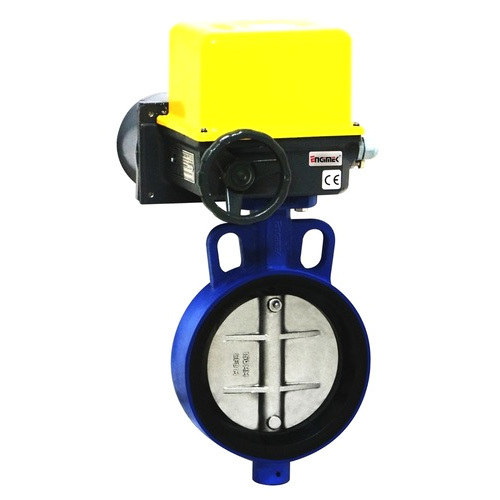
A complex control mechanism called an electrical butterfly valve is utilized in many industrial applications to manage the flow of liquids or gases via a pipeline. This sophisticated variation uses a circular disc or "butterfly" that pivots on a shaft to regulate the flow passage, just like a conventional butterfly valve. The electrical butterfly valve differs from other butterfly valves due to the inclusion of an electric actuator that enables automatic and accurate control of the valve's position.
Features:
- The Electrical Butterfly Valve provides exact fluid flow control, enabling precise changes in a variety of industrial applications.
- By enabling bidirectional flow control, this valve ensures effective operation regardless of the flow direction of the fluid.
- There is less need for physical intervention since this Electrical Butterfly Valve may be effortlessly controlled and changed remotely.
- The motorized actuator of the valve allows for quick modifications to fluid flow rates for increased process efficiency.
- The valve is built to withstand corrosion and is suitable for use in harsh settings, assuring endurance and dependability.
Purchase from us this substantial quarterly turn Electrical Butterfly Valve which is planned and created according to the modern guidelines by utilizing premium quality materials which confers more prominent strength and solidness to endure influence powers and liquid tensions. The focal circle and the encompassing body are covered with an electrifies covering that makes it reasonable for the destructive conditions. Clients can benefit our valves in different various sizes and plans according to their prerequisites.
Utilizations of Electrical Butterfly Valve:
1. Water Treatment Plants: Electrical butterfly valves are utilized in water treatment offices to control the progression of water through different phases of the treatment cycle, like filtration, chlorination, and dispersion. Mechanized control is pivotal for keeping up with exact stream rates and water quality.
2. Central air Frameworks: Warming, ventilation, and cooling frameworks use electrical butterfly valves to control the progression of air and water inside the framework. Mechanized valves can assist with enhancing temperature and air conveyance in structures, expanding energy productivity.
3. Modern Cycles: In ventures like substance, petrochemical, and drug fabricating, electrical butterfly valves are utilized to control the progression of different liquids like synthetic compounds, solvents, and gases. Computerized valves assist with keeping up with exact interaction boundaries and further develop wellbeing by diminishing manual mediation.
4. Power Age: Butterfly valves with electrical actuators are utilized in power plants to control the progression of steam, water, and gases inside the power age process. They are regularly found in applications like steam turbines and cooling frameworks.
5. Oil and Gas: In the oil and gas industry, electrical butterfly valves are utilized to manage the progression of unrefined petroleum, flammable gas, and refined items in pipelines, processing plants, and dispersion frameworks. Computerized valves improve the proficiency of activities and decrease the requirement for manual intercession.
6. Farming and Water System: Electrical butterfly valves assume a part in dealing with the progression of water for water system purposes. They assist with controlling water dissemination across fields and homesteads, improving water use and yield wellbeing.
7. Wastewater The Board: City sewage frameworks and wastewater treatment plants utilize electrical butterfly valves to coordinate the progression of wastewater through various treatment stages. Robotization guarantees appropriate taking care of and treatment of sewage.
8. Food and Refreshment Industry: These valves are utilized in the food and drink industry to control the progression of fluids and gases during handling and bundling. They are significant for keeping up with cleanliness norms and item quality.
9. Mining and Minerals Handling: In mining tasks, electrical butterfly valves are utilized to control the progression of slurry, synthetic compounds, and water in mineral handling, store filtering, and other extraction processes.
10. Marine and Shipbuilding: Electrical butterfly valves are introduced in boats and marine frameworks to direct the progression of liquids like seawater, counterweight, and fuel. Robotization works on the proficiency of vessel tasks.
11. Mash and Paper Industry: These valves track down applications in controlling the progression of fluids, synthetic compounds, and steam in different phases of the paper fabricating process.
Electrical Butterfly Valve Benefits:
1. Remote and Mechanized Control: One of the main benefits of electrical butterfly valves is the capacity to control valve activity from a distance and naturally. This controller highlight takes into account acclimations to be made without the requirement for manual mediation, making it more straightforward to oversee and improve processes.
2. Exact Stream Guideline: Electrical butterfly valves give exact command over the progression of liquids. The capacity to change the valve position in little augmentations considers precise stream guideline, which is fundamental in applications where explicit stream rates are required.
3. Speedy Activity: Butterfly valves are known for their fast opening and shutting times. When combined with electrical actuators, the reaction time can be additionally decreased, making these valves appropriate for applications that require quick changes.
4. Space-Effective Plan: Butterfly valves have a reduced plan contrasted with different sorts of valves, like door valves or globe valves. This makes them appropriate for establishments where space is restricted.
5. Lower Strain Drop: Butterfly valves for the most part have a lower pressure drop across the valve contrasted with different sorts of valves. This implies that they make less obstruction the progression of liquids, bringing about less energy misfortune and further developed generally speaking framework proficiency.
6. Practical: Electrical butterfly valves will generally be more financially savvy than a few different sorts of valves, both with regards to starting buy and support. Their less complex plan and diminished number of parts add to this cost advantage.
7. Low Upkeep Prerequisites: With less moving parts and a smoothed out plan, electrical butterfly valves frequently require less support and overhauling. This can prompt diminished margin time and functional interferences.
8. Strength: Butterfly valves are intended to deal with a large number of liquids, including destructive and rough substances. Their hearty development, joined with progressions in materials and coatings, improves their sturdiness and life span.
9. Reasonable for Huge Measurement Applications: Electrical butterfly valves are accessible in various sizes, including enormous distances across. This makes them reasonable for applications where significant stream rates should be controlled.
10. Flexibility: These valves are adaptable and can be utilized across various businesses and applications, from water treatment and central air frameworks to modern cycles and power age.
11. Energy Productivity: The effective plan of butterfly valves adds to energy investment funds, particularly when mechanized controls are utilized to streamline stream rates and limit pointless energy utilization.
12. Mix with Control Frameworks: Electrical butterfly valves can be handily incorporated into bigger control and robotization frameworks, considering consistent coordination with different cycles and gadgets.
13. Security: Mechanized control decreases the requirement for manual mediation in possibly perilous conditions, upgrading specialist wellbeing.
FAQ:
Q. What is an electrical butterfly valve?
Ans: An electrical butterfly valve is a kind of valve that utilizes a circle, frequently molded like a butterfly, to control the progression of liquids ready to go. The circle turns inside the valve body, considering exact stream guideline. An electrical actuator is utilized to robotize the opening and shutting of the valve.
Q. How does an electrical butterfly valve function?
Ans: An electrical butterfly valve works by utilizing an electrically fueled actuator to pivot the circle inside the valve body. At the point when the plate is opposite to the stream course, the valve is shut, and when it's lined up with the stream heading, the valve is completely open. Middle plate positions take into consideration halfway stream control.
Q. What are the benefits of utilizing electrical butterfly valves?
Ans: Electrical butterfly valves offer benefits, for example, remote and computerized control, exact stream guideline, speedy activity, space proficiency, lower pressure drop, cost-viability, low upkeep necessities, sturdiness, reasonableness for enormous widths, flexibility, energy effectiveness, and combination with control frameworks.
Q. Where are electrical butterfly valves utilized?
Ans: Electrical butterfly valves are utilized in different ventures and applications, including water treatment plants, air conditioning frameworks, modern cycles (synthetic, petrochemical, and so on), power age, oil and gas, agribusiness and water system, wastewater the executives, food and drink, mining, marine, and that's just the beginning.
Q. What are the principal parts of an electrical butterfly valve framework?
Ans: The fundamental parts incorporate the valve body, circle (in some cases alluded to as the "butterfly"), actuator, positioner (for exact control), control framework (which can incorporate sensors and computerization rationale), and power supply.
Q. What sorts of actuators are utilized for electrical butterfly valves?
Ans: Electric actuators, which can be fueled by AC or DC electrical sources, are regularly utilized for electrical butterfly valves. These actuators can be additionally grouped into types like electric engine driven actuators and electro-water powered actuators.
Q. Could electrical butterfly valves at any point be controlled from a distance?
Ans: Indeed, electrical butterfly valves can be controlled from a distance. The mechanization capacities of these valves take into consideration controller and changes, frequently through a control framework or human-machine interface (HMI).
Q. Are electrical butterfly valves reasonable for destructive liquids?
Ans: Indeed, electrical butterfly valves can be planned with materials and coatings that make them appropriate for taking care of destructive liquids. Determination of the suitable materials is vital to guarantee similarity with the liquid being conveyed.
Q. What upkeep do electrical butterfly valves require?
Ans: Electrical butterfly valves by and large require less support because of their less difficult plan and less moving parts. Be that as it may, ordinary examination, cleaning, oil (if appropriate), and incidental adjustment of the control framework are prescribed to guarantee legitimate usefulness.
Q. Might electrical butterfly valves at any point deal with high-pressure applications?
Ans: Indeed, electrical butterfly valves can be intended to deal with high-pressure applications. The decision of valve size, materials, and development will rely upon the particular tension prerequisites of the application.
Q. Are electrical butterfly valves reasonable for choking applications?
Ans: Indeed, electrical butterfly valves can be utilized for choking applications to control stream rates. In any case, they are frequently liked for on-off or adjusting applications
Superior Durability & Corrosion ResistanceBuilt with a robust ductile iron or stainless steel body and an epoxy-painted finish, this butterfly valve resists corrosion in demanding environments. Combined with advanced seat materials such as EPDM, NBR, or PTFE, users can expect excellent longevity, minimal maintenance, and reliable sealing performance across water, gas, oil, or air applications.
Flexible Mounting and CompatibilityFeaturing an ISO 5211 mounting standard, this valve allows easy actuator installation and smooth interchangeability. The wafer/flange compatible end connection ensures seamless integration into existing pipelines, while its wide port size range (50 mm to 300 mm) accommodates diverse system requirements in water treatment, HVAC, and industrial settings.
Reliable Control & Quick ResponseThe high-performance electric actuator offers precise on/off quarter-turn operation, supported by a clear visual position indicator. Rated to IP67, it delivers reliable actuation in tough environments. With a quick-response design, low torque actuation, and over 50,000 cycle life, this valve suits automated systems demanding fast and consistent flow control.
FAQ's of Electrical Butterfly Valve:
Q: How is the Electrical Butterfly Valve installed in a piping system?
A: The valve is designed with ISO 5211 mounting for straightforward actuator installation and features wafer or flange-compatible end connections. To install, align the valve between compatible flanges in your pipeline, securing it with appropriate bolts, and connect the actuator's power supply (24V DC or 230V AC) via its 2-pin connection.
Q: What types of media can the valve control effectively?
A: This valve is engineered to handle a variety of media, including water, gas, oil, and air. Its versatile seat materials-EPDM, NBR, or PTFE-ensure chemical compatibility and reliable sealing across a broad range of industrial and utility applications.
Q: Where can this valve be used most effectively?
A: It is ideal for water treatment plants, HVAC systems, and industrial fluid control scenarios. The robust design, corrosion-resistant materials, and precise electric actuation make it suitable for demanding environments requiring automated on/off flow control.
Q: What are the steps involved in operating the valve?
A: Once installed and powered, the actuator receives electrical signals to rotate the valve disc 90, either fully opening or closing the valve. The visual position indicator shows the valve's status, enabling operators to confirm correct alignment at a glance.
Q: When should I choose this valve over a manual valve?
A: Choose this electrically actuated butterfly valve when you require automated, remote, or rapid control in your system, such as for process automation, safety shutoffs, or hard-to-reach installations-especially where frequent operation or integration with control systems is necessary.
Q: What benefits does the IP67 enclosure provide?
A: The IP67-rated actuator enclosure protects internal components from dust and temporary immersion in water, enhancing reliability and extending operational life, particularly in harsh or moisture-prone environments.
Q: How does this valve support long-term reliability?
A: Engineered for over 50,000 life cycles and constructed with durable materials, the valve is designed for extended service life. Its corrosion-resistant body, robust actuator protection, and high-quality seating materials ensure consistent and reliable operation throughout its use.





 Send Inquiry


 Send Inquiry
 Send Inquiry
 Send SMS
 Call Me Free